Friday, January 28, 2011

How is this Expos 101 thing supposed to work anyway?

As we begin work on the first of the five papers that will follow, it might be just the right time to think about what it is that Expos 101 is meant to teach and achieve. Here is Prof. Kurt Spellmeyer, the director of the writing program and one of the editors of The NHR, addressing exactly this issue.

WATCH VIDEO (sorry couldn't get it to embed in the post)

One thing that is clear from this video is that paper 1 (or any other paper for this class) cannot simply be a summary of the author’s argument. The paper must say something about the essay or as Kurt puts it “be able to use it”. The best bet for using it is a paper that considers the implications of the author's argument. In other words, writing the paper means asking ourselves: why is Siebert’s argument important? How does it make a conceptual change to the way we think or live? Hence the assignment question which encourages you to think in terms of the newness of Siebert’s argument.

Writing, peer reviewing and grading also brings us to the most demanding and unrelenting part of the semester. From here it will only get really tough for all of us and there is no way of escaping that. The good thing, though, is that I know, from past experience, that it gets better. The catch? It gets better only after it is over

Oh! and trivia: Prof. Spellmeyer is also a Zen master and has been running the Cold Mountain Sangha  at Rutgers for many years now. And where does the Sangha mainly meet? : the Livingston Tutoring Center where you are all going to sign up for tutoring pretty soon (and no they don't automatically sign you up for zen)! 


Thursday, January 27, 2011

Human-Elephant Relationship

Siebert believes that the way that people see animals, or more specifically, elephants, is geared by the way that people see themselves. He sees the connection between elephants and humans as very distinct. Siebert describes the connection in a broad sense and even goes as far as to use a metaphor to relate the two, saying, “…People are animals” (534). His fellow researchers see a deeper, more subtle connection between elephants and humans. Gay Bradshaw, for example, a fellow researcher, finds the connection to be more focused on people’s psyches. By focusing on the psyche-connections between humans and elephants, humans can better understand the “frame of reference” of elephants and in effect relate to them much better.

Repetitious Redundancy

Rehabilitated, reintroduced, re-unite, these words center about redundancy and repetition. To mend the tears of the elephant society, people must “participate actively” and continuously. Siebert describes the “new trans-species psyche” as an “uncharted frontier.” One cannot hope to discuss a topic and systematically know all there is, understanding takes time; time which is needed to fully comprehend the broken stability in elephants and to adequately aid in the recovery of their damaged psyches.

The Sheldrick Trust has proven successful in the rehabilitation of many elephants: this success has remained in the “elephant’s collective memory” and because of this elephants return to the sanctuary. Elephants return “with their own wild-born calves” hoping that the sanctuary can serve as “allomothers” to this new generation of elephants as they served to the now matured and healed elephants. Anthropomorphically, elephants are recognizing the need for help with their trauma. Redundancy is the key to growth. Consequent returns of rehabilitated elephants prove success in repetition.

Healed Elephants

The dream of human and elephant coexistence is now being outwardly displayed by successfully rehabilitating elephants by human trainers. Healed elephants from the sanctuary are returned with their newly, wild-born calves to be introduced to their “human allograndmothers”. This illustrates that elephants, like humans, have an intricate “web” of social tiers. Elephants are beginning to associate humans as their own. This connection is “mutually benefiting interspecies culture”. OED definition of word "mutually" is “so as to reciprocate the same or an equivalent action, feeling, or effect”. It is benefiting our relationship between animals like elephants and humans. Sheldrick Trust, I think, is only the beginning of the “interspecies culture”. With this continuing effort, I think we will fully appreciate the complex similarities between elephants and us.

The Necessity for Cooperation

Siebert decided to share with us how the elephants were able to become rehabilitated and the outcome of this process, which he made seem as if it were very successful. “the trust and the sanctuary are the beginnings of a mutually benefiting inter-species culture”(538). The word mutually is a very common word, but within the texts, and understanding the definition which is “In a mutual relation; so as to reciprocate the same or an equivalent action, feeling, or effect; reciprocally” (OED) makes this a very powerful statement. The use of this word shows that the work put into rehabilitating is equally helpful to humans as well as healing the elephants. Siebert also uses the word “allomothers” (538) and also “new subs-species” (538) within his text which I believe is extremely important when used together. The word “allomothers” (538) alone means a substitute guardian that plays the role of a mother, but when combined with the phrase “new subspecies” which broken down can be deduced to mean “A subdivision of a species; a more or less permanent variety of a species” (OED) really shows how impacting this rehabilitation is to the relationship between man and elephants. Before this quote, Siebert discussed the fabric of the elephant society being frayed. I feel as if this new quote can be described as the same fabric being repaired by the help of the human fabric. As if humans and elephants, both being damaged and frayed, can come together to create a new fabric, just as Siebert said “a whole new sub-species” (538). Siebert quoted Bradshaw saying “Now humans can participate actively in the healing of both themselves and non-human animals” (538). This only strengthens the idea that the human and elephant interaction can benefit both parties. My interpretation of Siebert’s quote was that humans and elephants can use one another and become related to initiate being a better being.

Elephant Love


Charles Siebert, author of “An Elephant Crackup”, talks about how the Sheldrick trust has successfully rehabilitated over 60 elephants to date. During this time, a new subspecies has developed: human allograndmothers. This means that elephants have become so used to interacting with humans that they often bring their offspring back to the sanctuary to experience this “trans-species psyche”. Siebert uses the word psyche here to show how humans and elephants share similar mind traits. All of this has led to “Now humans can participate actively in the healing of both themselves and non-human animals. The trust and the sanctuary are the beginning of a mutually benefiting interspecies culture” (Siebert 538). Siebert uses interspecies to show how two species have benefited from eachother.

Trans-Specie Family


In the extract from Siebert's "An Elephant Crackup", he shares a fresh perspective on how the elephant family structure may be significantly evolving. Originally he introduces the term allomother to distinguish the relationship that some animals are developing with humans that care for them. Since the elephants don't share the anthropocentric mentality that us humans possess, it seems that they can more easily accept other species as their own. In this quote Siebert says that elephants sometimes return to the sanctuary after some years to introduce their offspring and to indirectly show their caretakers. This shows that elephants recognize their caretakers as so much more than simply the people that give them food or clean up their dung. Siebert introduces the word "allograndmothers" to describe the roles that the humans play in the elephants' family structure.

On the other hand, the idea of inter-species culture is still completely foreign to us. This is evident in the fact that our language doesn't even provide a proper way to describe this kind of relationship with the animals. Siebert was forced to create new words to be able to convey this idea in his essay. Maybe we can learn from the animals though, and familiarize ourselves with this alternate culture.

Sheldrick Trust

Currently humans are becoming connected with elephants in a trans-species way. Elephants that had been traumatized during their childhood as a result of seeing their personal mother or elder die; these elephants are currently being rehabilitated by companies such as the Sheldrick Trust. The Sheldrick Trust is successful because they replace the traumatized elephants previous mother with an allograndmother, which provides the love and care to the elephants that didn't receive that affection needed because of the loss of their elder. When the humans help cure the traumatized elephants, both the elephants and human will benefit from this because it provides a source of healing.

Wednesday, January 26, 2011

The New Trans-Species Psyche

Charles Siebert’s essay “An Elephant Crackup” captures the healing process of both elephants and humans from the warfare that has caused devastation on both sides. The Sheldrick Trust has made it their goal to rehabilitate elephants for their eventual return to elephant society, and one of the byproducts of this symbiotic relationship is that elephants are now recognizing a new sub-species: the human allograndmothers. This is a big step to the successful healing of human-elephant relations because the elephants realize the role that their caretakers play in their lives. They are able to distinguish the distinct difference between their previous captors and poachers with their new “elders” who have helped heal them from their past traumas and mistreatment. The passage even goes so far to say that elephants who had been successfully reintegrated back into the wild have returned with their young to visit the sanctuary and their human allomothers. This indicates that those elephants are no longer afraid of humans, at least those in the sanctuary, because of the compassion that they were shown during their stay.

One of Siebert’s claims in the passage is that “the trust and the sanctuary are the beginnings of a mutually benefitting interspecies culture” (538). This implies that both the elephants and the humans are benefitting from the experience which makes sense because of the amount of effort that is involved in making this enterprise be successful is enormous. The elephants are receiving treatment for their past traumas and wounds at the hands of poachers and captors who caused them to live a life of fear. But this is also beneficial to the humans because they have dedicated their life to helping another animal in need and as such they have changed their mindset from one of self-centeredness to one of anthropomorphism. The basis for this new thinking lies, according to Bradshaw, in the fact that “traditionally, nature has served as a source of healing for humans”. In this case, nature is the uniting factor that has brought humans and elephants together at the sanctuary, and that unity has created a new trans-species psyche that will hopefully alleviate all tensions between us.

Humans and Elephants Coexisting

Charles Siebert writes that the Sheldrick Trust has rehabilitated many elephants and brought them back into the wild. It is interesting to note that Siebert uses the word rehabilitate to describe the situation. The word rehabilitate is usually associated with alcoholics and drug addicts when they are trying to kick the habit. As he does throughout the essay he uses words normally associated with humans to describe elephants. Later in the essay, he describes elephants bringing their young to their old human 'allomothers'. This again illustrates the point that elephants have developed a 'trans-species psyche' with humans. Siebert hopes that we return the favor and treat elephants more like humans. Bradshaw says that "Traditionally, nature has served as a source of healing for humans." Bradshaw also hopes that humans can help in the healing of other animals. He uses the phrase 'mutually benefiting interspecies culture' to describe his vision where animals as well as humans' sentiments are given weight and value.

Tuesday, January 25, 2011

To Be or Not to Be.... an Elephant


Charles Siebert explains that Sheldrick Trust has rehabilitated elephants and reintroduced them back into the wild. According to the OED, rehabilitate is defined as “To restore to former privileges, status, possessions, etc., by official decree or declaration.” By stating that we are rehabilitating the elephants, Siebert is showing that they are no longer in their rightful standing. This is because we took it from them. By killing thousands of adult elephants, we have left the young elephants without elders to teach them how to become the happy and social animals that they would naturally be. Because we, as humans, have caused this problem, we MUST be the ones to fix it and help them. In other parts of his article, Siebert has tried to convince us that we, because we are so similar to elephants, actually are elephants. This would mean that if the elephants are not in their rightful standing, then we are not either. If we are mistreating these elephants, then we are not doing what we should be doing, which is living in harmony with them, and we are destroying the reputation of human beings to the other animals. Siebert told us that elephants are social with a detailed communication system. Therefore, they usually understand what is going on around them. If the elephants know that we are destroying them as a species, how should we expect them to ever trust us when we are trying to do the right thing, such as putting them in a protected habitat or rehabilitating them in an elephant sanctuary? We are only making it more difficult on ourselves to do the right thing for the elephants.

In addition, there was something else interesting that I noticed in the end of the passage. Bradshaw tells “‘Now humans can participate actively in the healing of both themselves and non-human animals.’” Bradshaw says that, not only are we helping the elephants, but also we are helping ourselves to heal. According to the OED, healing is defined as “Mending, reparation, restoration of wholeness, well-being, safety, or prosperity.” If we are healing ourselves, then we are restoring our own wholeness. This means that we are not currently whole. Because we hurt the elephants as a species, we have hurt ourselves as well. We are damaged in the sense that, not only are we not achieving everything that we possibly can (or being the best that we can be,) but we are not even capable of doing so because our mindset has shifted and disabled us from reaching our full potential. Until we are capable of becoming elephants and treating them as equals, we are limiting ourselves. We do know have the wisdom or power to make the most of our lives. In order to fix this problem, we must achieve what Siebert describes as the “trans-species psyche.” This means to put us on the same level as the elephants, to be equals and friends. We must be one in our fight to live our lives to the fullest on the planet that we both call home.

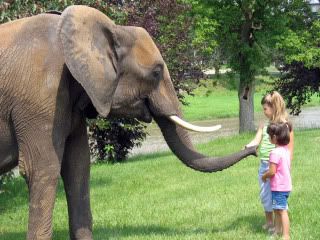
Thank you to trip advisor for the lovely elephant photo.

Trans-species Culture


To date, the Sheldrick Trust has successfully rehabilitated more than 60 elephants and reintroduced them into wild herds. A number of them have periodically returned to the sanctuary with their own wild-born calves in order to reunite with their human allomothers and to introduce their offspring to what — out on this uncharted frontier of the new ‘‘trans-species psyche’’ — is now being recognized, at least by the elephants, it seems, as a whole new subspecies: the human allograndmother. ‘‘Traditionally, nature has served as a source of healing for humans,’’ Bradshaw told me. ‘‘Now humans can participate actively in the healing of both themselves and nonhuman animals. The trust and the sanctuary are the beginnings of a mutually benefiting interspecies culture.’’ (538)

This passage from Seibert’s “An Elephant Crackup” describes the rehabilitation and reintroduction of over sixty abused elephants into the wild. He writes of the elephants who come back to their human mothers and introduce their children to their allograndmother, a human figure in their lives who they have learned to trust. Bradshaw explains that, “Traditionally, nature has served as a source of healing for humans.” This idea follows Seibert’s idea of trans-species psyche, a relationship between humans and elephants. Bradshaw also explains that “Now humans can participate actively in the healing of both themselves and non-human animals”, meaning that the close relation of the human and elephant psyche affords us the ability to form a “mutually benefitting interspecies culture”, as Seibert describes.

Human-Elephant Bonds

“To date, the Sheldrick Trust has successfully rehabilitated more than 60 elephants and reintroduced them into wild herds. A number of them have periodically returned to the sanctuary with their own wild-born calves in order to re-unite them with their human allomothers and to introduce their offspring to what – out on this uncharted frontier of the new “trans-species psyche” – in now being recognized, at least by the elephants, it seems, as a whole new subspecies: the human allograndmothers. “Traditionally, nature has served as a source of healing for humans,” Bradshaw told me. “Now humans can participate actively in the healing of both themselves and non-human animals. The trust and the sanctuary are the beginnings of a mutually benefiting interspecies culture.” (538)

In this quote, Siebert is discussing the effects of rehabilitation on the elephants. He quotes another researcher, Bradshaw, on this topic. In this particular section, Siebert is looking at the intense bond between the rehabilitated elephants and their caretakers. When he notes that some of the released elephants actually come back to the Sheldrick Trust to introduce their calves to the caretakers, as if the caretakers were their parents, which is fascinating. This shows the strong sense of family between the elephants, regardless of the species, so Siebert describes it as a “trans-species psyche”. Psyche, as defined by the Oxford English Dictionary as “the mind, soul, or spirit, as distinguished from the body”, says that there is a connection of the soul that the elephants feel towards their human allomothers, or the allograndmothers, for the calves. The particular usage of the word psyche shows that Siebert is clearly saying that the humans and elephants are thought one in the same. The end quote from Bradshaw, “the trust and sanctuary are the beginnings of a mutually benefiting interspecies culture”, signifies this bond between the humans and elephants even further.

One Must Go Back in Order to Go Forward

Rehabilitation, or the act of restoring to a normal condition, gives one the sense that these creatures are given a second chance in life. Within the first sentence and a half of this quote (538), the prefix ‘re’, which means to go back or form again, was used four times: “rehabilitated”, “reintroduced”, “returned”, and “re-unite”. Not only do these words suggest a new beginning for the elephants that were lucky enough to go to the sanctuary, but within the context of the text, it seems that these elephants are able to live a better life and are truly thankful for this opportunity. They show this by bringing their calves back to the humans who have helped them recover, implying that the baby calf would not have been possible without the help of these humans. For humans, the fact that the animals are grateful and regard them as members of their family (human allograndmother), creates a fulfilling feeling. Both animal and human are able to feed off each other to create a better life. From all of the acts of going backwards to change the past of the elephants, the start of something new was created, a human-elephant culture. This may be thought of as a “trans-species psyche”, or else the idea that both species share a mutual mindset and desire for positive emotion.